
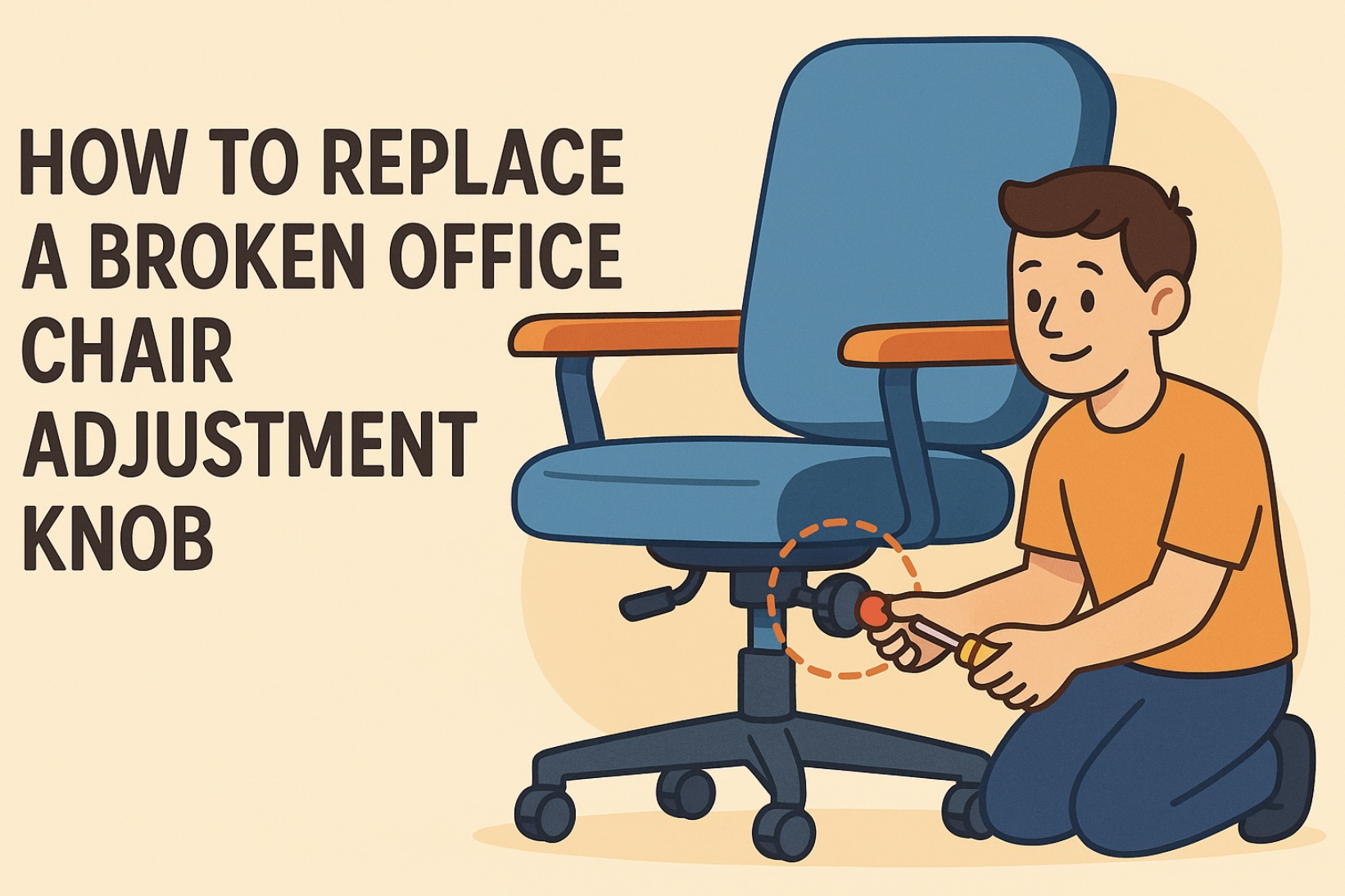
The adjustment knobs on your office chair do more than just tweak comfort. The tilt tension knob, lumbar knob, and other controls help you set the chair so it supports your posture instead of fighting it. When a knob cracks, strips, or falls off, you lose fine control over the mechanism and often put extra stress on the tilt plate and springs. Replacing a broken adjustment knob instead of ignoring it is a quick, inexpensive fix that can prevent bigger repairs later.
Common Types of Office Chair Adjustment Knobs
Not every chair uses the same knobs, but most ergonomic models include at least one of these:
- Tilt tension knob: Usually a large round knob under the front or center of the seat that controls how easily the chair reclines.
- Multi-function tilt knobs: Some chairs use side-mounted knobs for forward tilt, back angle, or seat depth.
- Lumbar support knob: On certain high-end chairs, a rear or side knob adjusts internal lumbar support.
This guide focuses mainly on tilt tension and under-seat knobs, but the same basic removal and replacement steps apply to many other knob styles.

HYEJDRV Heavy Duty 500LBs Office Chair Tilt Control Mechanism Replacement Parts, Office Chair Swivel Tilt Base W/6" x 10.2" Mounting Holes - Black

Salbree Office Chair Hero Fix Attaches Clamps to Large Cylinder Piston Stops Your Chairs from Sinking When Computer Hydraulic Lift Has No Gas Stop Replacement

Spidfee Fix Sinking Office Chair, Avoid Sinking of Office Chair Height-Adjustable Cylinder Replacement No Tools Needed
Step 1: Confirm What Is Actually Broken
Before you order parts, make sure it is the knob that is damaged, not the mechanism behind it.
- Look closely at the knob itself for cracks, missing chunks, or a stripped plastic insert.
- Check the metal shaft or stud the knob screws onto. If the threads are flattened or bent, you may need a new mechanism, not just a knob.
- Try turning the remaining stub with pliers. If you still feel the tilt tension changing, the internal spring and mechanism likely still work.
- If the knob spins freely without resistance, the problem may involve the tilt tension spring inside the mechanism rather than just the knob.
If you suspect the spring or mechanism is at fault, it is worth reviewing a spring-focused guide such as how to identify and replace office chair tilt tension springs before you commit to a parts order.
Step 2: Remove the Broken Knob
Most adjustment knobs simply screw onto a threaded shaft, but some use clips or hidden fasteners.
- If part of the knob remains, try turning it counterclockwise while supporting the mechanism so you do not stress the tilt plate.
- If the plastic shell is shattered, use pliers to grip the inner hub and unscrew it from the shaft.
- Check for small screws or caps on the face of the knob. Some designs hide a screw under a decorative plug.
- If the knob refuses to move, apply a small amount of penetrating oil to the threads and let it sit a few minutes before trying again.
Once the knob is off, clean any dirt or plastic fragments from the exposed threads with a rag or a soft brush.
Step 3: Measure the Shaft and Choose a Compatible Replacement
Getting the right replacement knob is mostly about matching thread size and overall style.
- Use calipers or a small ruler to measure the diameter of the threaded shaft.
- Count the number of threads over a short distance or compare it to a known bolt to estimate the thread pitch.
- Note the shape you prefer (star knob, round knob, or wing grip) and how much clearance you have under the seat.
- Take a quick photo of the shaft and surrounding area so you can compare it to product photos.
A good starting point is to search for a generic knob upgrade like a replacement tilt tension knob for office chairs. You can also find heavy-duty options under broader searches such as star grip knobs if you know your thread size.
HYEJDRV Heavy Duty 500LBs Office Chair Tilt Control Mechanism Replacement Parts, Office Chair Swivel Tilt Base W/6" x 10.2" Mounting Holes - Black
Salbree Office Chair Hero Fix Attaches Clamps to Large Cylinder Piston Stops Your Chairs from Sinking When Computer Hydraulic Lift Has No Gas Stop Replacement
Spidfee Fix Sinking Office Chair, Avoid Sinking of Office Chair Height-Adjustable Cylinder Replacement No Tools Needed
Step 4: Decide Whether to Replace Just the Knob or the Whole Tilt Mechanism
Sometimes a broken knob is only a symptom.
- If the knob cracked but the shaft and mechanism look clean and straight, a simple knob swap is usually enough.
- If you see rust, bent hardware, or oil leaking from the tilt mechanism, you might be better off replacing the entire tilt plate assembly.
- Chairs that rock unevenly, feel loose at the base, or wobble when you lean back may have deeper structural issues that a new knob will not fix.
- When in doubt, price out both a replacement knob and a full office chair tilt mechanism replacement and compare that to the cost of a new chair.
If your chair already has a noticeable wobble, it is smart to walk through the step-by-step checks in why your office chair wobbles and how to fix it fast as part of this repair.
Step 5: Install the New Adjustment Knob
Once you have a compatible replacement, installation is usually straightforward.
- Dry-fit the new knob by threading it onto the shaft by hand. It should start easily without cross-threading.
- Turn the knob clockwise until it bottoms out gently, then back it off slightly so you still have room to adjust tension.
- If the new knob includes a small set screw, tighten it last to lock the knob onto the shaft.
- Verify that the knob does not rub on the underside of the seat or any nearby plastic covers.
If the threads feel gritty or tight, remove the knob and lightly clean the shaft again. You can also apply a tiny dab of general-purpose multi-purpose grease to the threads to help it spin smoothly.
Step 6: Adjust the Chair and Test the Mechanism
With the new knob installed, you can set up the chair so it feels right again.
- Sit in the chair and recline gently while turning the knob to find a comfortable tilt tension.
- If the knob is for a lumbar or depth adjustment, turn it through its full range to confirm that the internal parts move without grinding or binding.
- Listen for squeaks, creaks, or pops as you move. Noises here usually mean another joint or spring could use lubrication or tightening.
- Once everything feels good, mark the underside of the seat or note how many turns from loose to tight help you quickly find your preferred setting later.
If you discover new squeaks while testing, you can follow a dedicated noise-fix walkthrough like the guide on how to fix a squeaky office chair in 10 minutes or combine this job with a broader tune-up based on preventive maintenance tips for office chair longevity.
Extra Tools and Parts That Make the Job Easier
Replacing a knob is simple, but having the right basic kit will speed everything up.
- A compact Allen key set for common chair bolts.
- A small combination wrench set for nuts on the tilt plate and base.
- A basic office chair repair kit that includes spare bolts, washers, and sometimes extra knobs.
- Thread locker for bolts you do not want working loose again.
If you notice other issues while you have the chair flipped over, it is often more efficient to tighten hardware, lube pivot points, and clean casters during the same session.
Salbree Office Chair Hero Fix Attaches Clamps to Large Cylinder Piston Stops Your Chairs from Sinking When Computer Hydraulic Lift Has No Gas Stop Replacement

Office Chair Sinking Fix Kit to Stop Sink|Made of Steel Strong Enough to Support Maximum 800 Pounds | No More Sink &No Need to Replace Chair Gas Lift Cylinder - Silver

Besezx Leather Repair Patch Tape Kit, Self Adhesive Leather Repair for Furniture, Couch, Sofa, Car Seats,Office Chair,Vinyl Repair Kit.3.1inx60in
Preventing Future Adjustment Knob Breakages
Most broken knobs fail from a combination of age, brittle plastic, and heavy-handed adjustment.
- Avoid forcing the knob past its natural stop point. If it will not turn further, the mechanism is likely at its limit.
- Make adjustments while seated in a neutral posture rather than leaning all your weight back or forward.
- Keep the area under the seat clean so dust and grit do not work their way into moving parts.
- Include the knob and tilt mechanism in your regular chair checkup routine instead of waiting until something cracks.
A light but regular maintenance routine, like the one outlined in the site’s broader longevity guides, will keep your knobs, springs, and mechanisms working together instead of fighting each other.
Conclusion
A broken office chair adjustment knob is annoying, but it is rarely a reason to replace the whole chair. By identifying which knob failed, confirming that the underlying mechanism still works, and matching a simple threaded replacement, you can restore full control over your tilt or support settings in a single afternoon. Combine the knob swap with a quick inspection of the base, casters, gas lift, and tilt plate, and you will not only fix the immediate problem but also reduce the chance of more expensive repairs down the line.

