When an office chair starts sinking, refuses to stay at the right height, or develops a loose feel at the base, the gas lift is usually the first part people look at replacing. That is where one of the biggest buying questions comes in: should you buy a universal gas lift or a brand-specific one?
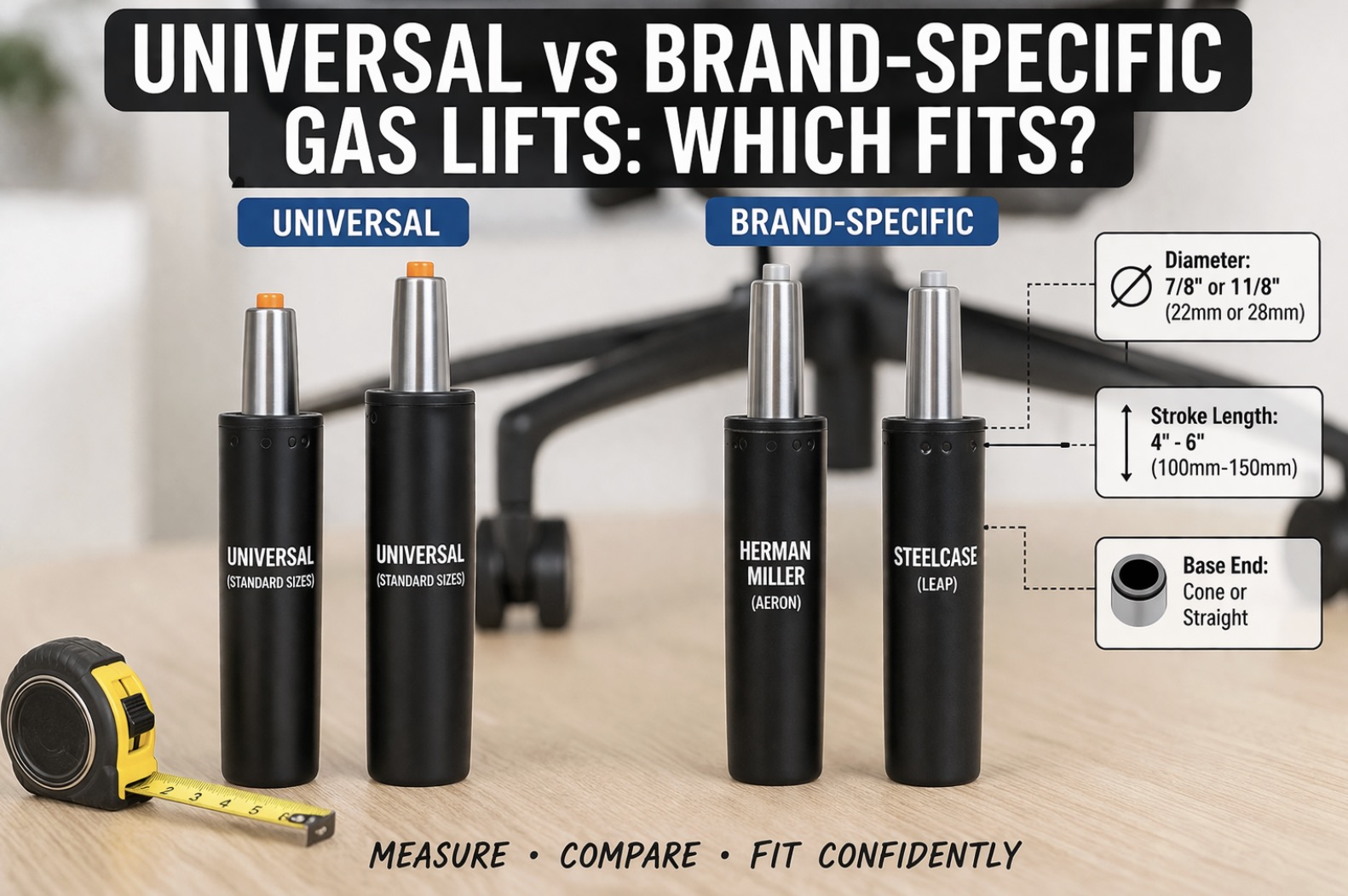
At first glance, universal gas lifts seem like the easy answer. They are widely available, usually cheaper, and often marketed as fitting “most office chairs.” Brand-specific gas lifts, on the other hand, are designed for a particular chair line or manufacturer and are usually sold with stronger compatibility claims but at a higher price. The problem is that neither option is automatically the right choice for every chair.
The real answer depends on fit, measurements, chair type, intended seat height, and whether your chair uses a standard tapered connection or a more specialized design. In some cases, a universal office chair gas lift cylinder works perfectly and saves money. In other cases, a brand-specific office chair gas lift is the safer choice because it preserves the original seat height, travel range, and overall feel of the chair.
If you are trying to avoid guesswork, this comparison will help you understand what “universal” really means, when brand-specific parts are worth paying for, and how to decide which type is more likely to fit your chair correctly.

FLKQC Universal Office Chair Gas Lift Cylinder Replacement, 5.5" Long Stroke Gas Lift, Heavy Duty Gas Lift Hydraulic/Pneumatic Piston for Office Chair/Gaming Chair

Omyoffice 5.5 inch Office Chair Gas Lift Cylinder-Office Chair Replacement Parts,Universal Size Fits Most Chairs,Heavy Duty Gas Lift Hydraulic/Pneumatic Piston(Black)

DOZYANT Gas Lift Cylinder Replacement,Hydraulic Pneumatic Shock Piston Heavy Duty (450 lbs) Universal Size Fits Most Executive Office Chairs, Highest End Class 4
What a Gas Lift Actually Has to Match
A gas lift is not just a cylinder that raises and lowers the seat. It also determines the chair’s usable height range, affects how solid the base feels, and has to fit correctly into both the seat mechanism and the chair base.
For a replacement gas lift to fit properly, several things need to line up:
- The top and bottom taper fit must be compatible with the chair mechanism and base.
- The overall length must be close enough to the original.
- The compressed length must preserve the chair’s minimum seat height.
- The stroke length must preserve the adjustment range.
- The duty rating should match the chair type and user weight.
That is why simply buying the first “universal” listing you see is risky. Even if the part physically installs, the chair can still sit too high, bottom out too low, or feel wrong during daily use.
If you need a full walkthrough of the replacement process itself, see Office Chair Replacement Piston Gas Cylinder & Repair.
What “Universal” Usually Means
When a seller calls a gas lift universal, they usually mean it is built around the common tapered office-chair connection used by many task chairs, executive chairs, and gaming chairs. That can absolutely be useful, but the word “universal” often gets stretched far beyond what it should mean.
In practical terms, universal usually means:
- The cylinder uses a standard office-chair taper fit.
- It is intended for a broad range of mainstream chairs.
- It may work across many brands if the measurements are close enough.
- It is not guaranteed to preserve the exact original seat height or travel.
So universal does not mean “fits everything perfectly.” It usually means “fits many chairs with common dimensions.”
That distinction matters a lot. A universal cylinder can be mechanically compatible but still not be the best match for the way your chair originally sat or adjusted.
What Brand-Specific Usually Means
A brand-specific gas lift is sold for a particular manufacturer, chair family, or even a single model line. These parts are usually intended to match the original geometry and performance more closely.
That often means:
- The seat height range is closer to the original factory setup.
- The cylinder is more likely to match the original stroke length.
- The fit is more predictable if the seller or manufacturer clearly names your exact chair model.
- You may pay more for the added compatibility confidence.
Brand-specific parts become especially useful when the chair uses unusual dimensions, a premium design, or model-specific ergonomics that you do not want to alter by accident.
When a Universal Gas Lift Is Usually the Better Choice
A universal gas lift is often the better option when your chair uses a standard tapered setup and you can match the dimensions closely enough. This is common with many generic office chairs, budget ergonomic chairs, gaming chairs, and no-name executive models.
A universal option often makes sense when:
- Your chair is not a premium or highly specialized model.
- You can measure the old cylinder and compare the numbers accurately.
- You are comfortable accepting a close fit rather than an exact OEM match.
- You want a faster, cheaper replacement that restores normal function.
This is why many people start by browsing Class 4 office chair gas lift cylinders and heavy-duty office chair gas cylinders before looking for an exact brand label. In many ordinary chairs, that is enough.
FLKQC Universal Office Chair Gas Lift Cylinder Replacement, 5.5" Long Stroke Gas Lift, Heavy Duty Gas Lift Hydraulic/Pneumatic Piston for Office Chair/Gaming Chair
Omyoffice 5.5 inch Office Chair Gas Lift Cylinder-Office Chair Replacement Parts,Universal Size Fits Most Chairs,Heavy Duty Gas Lift Hydraulic/Pneumatic Piston(Black)
DOZYANT Gas Lift Cylinder Replacement,Hydraulic Pneumatic Shock Piston Heavy Duty (450 lbs) Universal Size Fits Most Executive Office Chairs, Highest End Class 4
When Brand-Specific Is Usually the Better Choice
Brand-specific is usually the safer choice when the chair is expensive, unusually engineered, or known to use parts that are not as standardized as mainstream office chairs.
You should lean toward brand-specific when:
- The chair is a premium ergonomic model and you want to preserve the original feel.
- The seller clearly lists your exact chair model and compatibility.
- The original chair height range is important to your ergonomic setup.
- The chair uses hardware or dimensions that seem less common.
- You have already tried a “universal” part before and the fit felt off.
This matters because a premium chair can still have a tapered gas lift, but the exact compressed height or travel may be more important than on a generic chair.
The Biggest Mistake: Assuming Fit Without Measuring
The biggest buying mistake is assuming that if a universal cylinder physically installs, it is automatically the correct replacement. Fit is about more than insertion diameter.
Before buying either a universal or brand-specific gas lift, you should compare:
- Overall length
- Compressed length
- Stroke length
- Chair type (standard, big-and-tall, drafting, gaming, ergonomic)
- Duty class or weight rating
That is exactly why Buying a Chair Gas Cylinder? Measure This First is such an important companion guide. It helps you avoid choosing a replacement that technically fits but changes the chair height or usability in a way you did not expect.
How Seat Height Can Change Even When the Part “Fits”
This is one of the most frustrating outcomes of choosing the wrong gas lift. You install the new cylinder, everything seems to fit, but now the chair sits too high at the lowest setting or does not rise high enough for your desk.
That usually happens because:
- The replacement has a different compressed length.
- The stroke length is shorter or longer than the original.
- The chair was originally designed around a more specific cylinder geometry.
In other words, physical compatibility is not the same as ergonomic compatibility.
If minimum and maximum seat height matter to you, this alone can be a strong reason to favor a closer brand-specific match—or at least a carefully measured universal one.
What About Premium Chairs?
Premium chairs are where buyers should be the most cautious. A universal cylinder may still fit some of them, but the higher the chair’s original quality and ergonomic tuning, the more likely it is that small dimensional differences will be noticeable.
That does not always mean you need OEM-only parts. It does mean you should avoid vague listings and make sure the replacement preserves the chair’s key dimensions. Premium users are often more sensitive to changes in height range, recline posture, and general feel because the original chair was bought for those details in the first place.
Universal vs Brand-Specific on Price
Price is one of the biggest reasons universal gas lifts are so popular.
- Universal gas lifts are usually easier to find and often cheaper.
- Brand-specific gas lifts usually cost more because of narrower compatibility and lower-volume sourcing.
If your chair is inexpensive, spending extra on a brand-specific cylinder may not always be worth it. But if your chair is valuable and otherwise in excellent condition, paying more for a better-fitting part can easily make sense.
A cheap replacement is only a bargain if the chair still feels right after installation.
Omyoffice 5.5 inch Office Chair Gas Lift Cylinder-Office Chair Replacement Parts,Universal Size Fits Most Chairs,Heavy Duty Gas Lift Hydraulic/Pneumatic Piston(Black)
FLKQC Universal Office Chair Gas Lift Cylinder Replacement, 5.5" Long Stroke Gas Lift, Heavy Duty Gas Lift Hydraulic/Pneumatic Piston for Office Chair/Gaming Chair

Huiguli Office Chair Cylinder Replacement - Heavy Duty Class 4 Hydraulic Pneumatic Gas Lift Cylinder(12" to 18" Adjustable, 1000 lbs Capacity) - Universal Fit for Most Executive Office Chairs
How to Decide Which One to Buy
If you are stuck between universal and brand-specific, this decision process usually works well:
- If the chair is generic and uses common hardware, start with a measured universal replacement.
- If the chair is premium, unusual, or highly ergonomic, look for a model-matched replacement first.
- If you cannot confirm dimensions, do not trust “universal” on its own.
- If the listing provides detailed size diagrams and weight ratings, it is usually a better sign than branding alone.
- If you care deeply about keeping the chair’s original seat height and feel, favor the closest match over the cheapest option.
This approach keeps you from overpaying when universal is good enough, but also keeps you from under-buying when exact fit really matters.
What Else to Check While Replacing the Gas Lift
If your chair feels loose, wobbly, or unstable, do not assume the cylinder is the only issue. Sometimes a worn base, loose seat bolts, or damaged hub connection makes the chair feel like it has a bad gas lift even when the real problem is elsewhere.
While the chair is apart, inspect:
- The five-star base for cracks.
- The seat plate bolts for looseness.
- The taper connection at the base and mechanism.
- Any unusual play or wobble around the central column.
That can save you from replacing the cylinder only to discover that the chair still feels unstable afterward.
So, Which Fits Better?
If the question is purely “which fits better,” brand-specific usually has the advantage because it is intended to match the original chair more closely.
But if the question is “which is more practical for most chairs,” universal often wins because many office chairs do use common gas-lift standards and can be repaired successfully with a well-measured universal replacement.
That leads to the most honest answer:
- Brand-specific usually fits more predictably.
- Universal often fits well enough—if the measurements truly match.
So the better choice is not really about the label. It is about whether the dimensions, travel, and duty class match your chair’s needs.
Conclusion
Universal vs brand-specific gas lifts is not a battle between “cheap and bad” versus “expensive and good.” Both can work. The real difference is how much compatibility confidence you need.
A universal gas lift is often the smartest option for standard office chairs when you can confirm the measurements and duty rating. A brand-specific gas lift is often the smarter option for premium, specialized, or dimension-sensitive chairs where preserving the original seat height and feel matters more.
The safest takeaway is simple: measure first, compare carefully, and treat “universal” as a starting category—not a guarantee. That is how you end up with a gas lift that not only installs, but actually fits the way your chair is supposed to work.

