Tilt tension and tilt lock are two of the most misunderstood controls on an office chair. People often use the terms interchangeably, but they do very different jobs. Tilt tension controls how much force it takes to lean back in the chair. Tilt lock controls whether the chair is allowed to recline at all—or in some cases, which recline position it stays in.
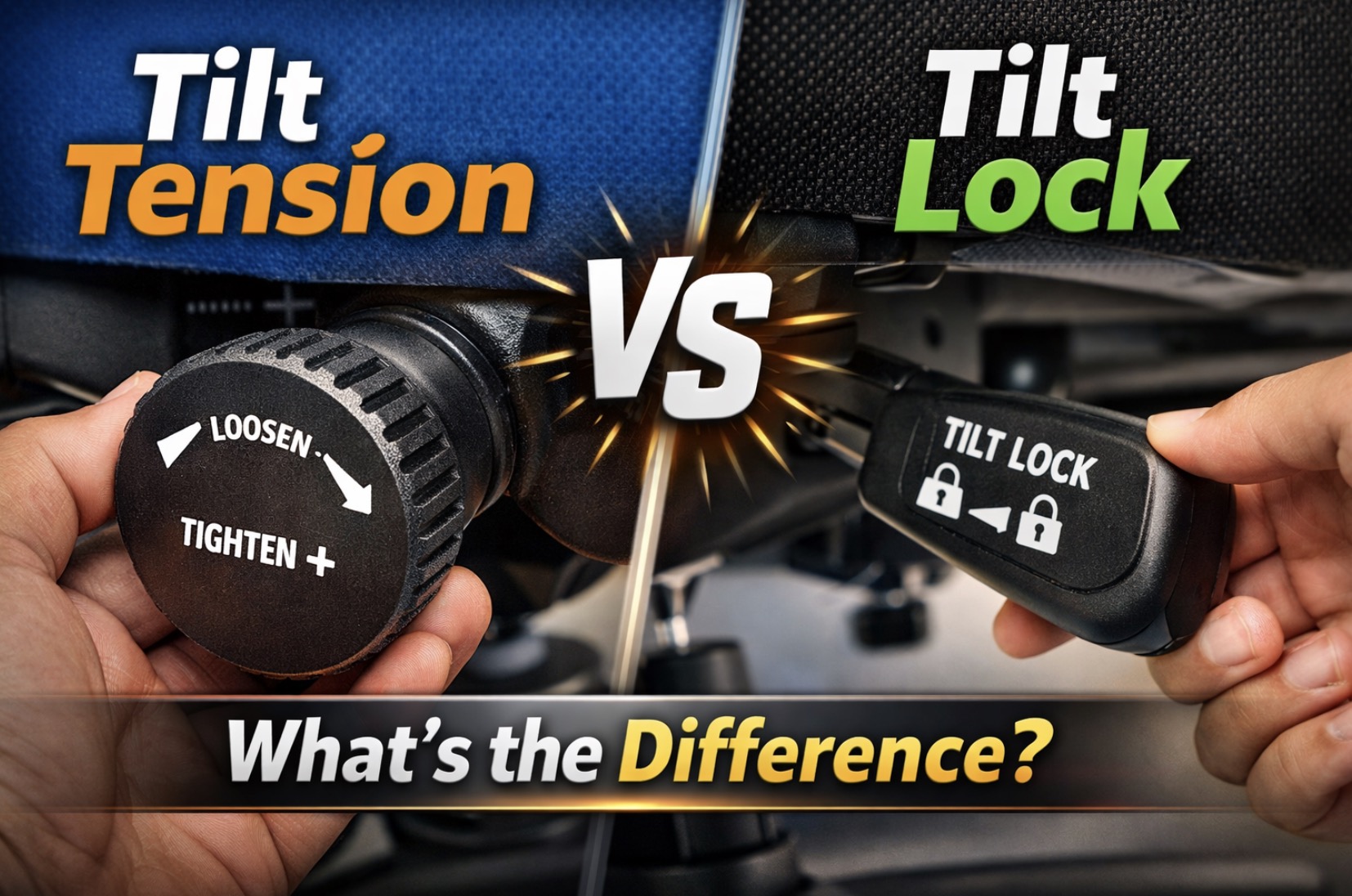
If you have ever turned a big round knob under your seat and wondered why the chair still would not lock upright, or pulled a side lever and wondered why the backrest suddenly felt harder to push, you are not alone. A lot of chair problems get misdiagnosed because users expect tilt tension and tilt lock to do the same thing. They do not.
Understanding the difference matters for comfort, posture, troubleshooting, and repairs. It also helps when you are buying replacement parts like a replacement office chair tilt mechanism, a tilt tension knob for office chairs, or even a chair recline lock mechanism and you need to know which part actually solves your problem.
What Is Tilt Tension?
Tilt tension is the control that changes how easy or hard it is to recline in the chair. On most office chairs, this is adjusted with a large round knob under the seat, usually near the front or center.
When you tighten tilt tension:
- The chair becomes harder to lean back in.
- The recline feels firmer and more resistant.
- Heavier users often prefer more tension for better support.
When you loosen tilt tension:
- The chair reclines more easily.
- The backrest feels lighter and more responsive.
- Lighter users usually find the chair more comfortable and usable.
Tilt tension does not lock the chair in place. It only changes the resistance you feel while reclining. If the chair still moves backward, even a little, that means the tilt lock is not engaged—or the chair does not have a lock at all.
If you want a deeper look at the spring and hardware behind this adjustment, see How to Identify and Replace Office Chair Tilt Tension Springs.
What Is Tilt Lock?
Tilt lock is the control that limits or stops the recline movement. On many chairs, it is a lever under the seat that locks the chair upright or unlocks it for free recline. On more advanced ergonomic chairs, tilt lock may allow several preset recline stops instead of just one upright position.
When tilt lock is engaged:
- The chair may stay upright and refuse to lean back.
- The backrest may only recline to one preset position.
- The recline range may feel restricted depending on the chair design.
When tilt lock is disengaged:
- The chair is allowed to recline.
- The user can lean back through the available recline range.
- Tilt tension then determines how much force that recline takes.
Tilt lock does not control how hard it is to recline. It only controls whether reclining is allowed or restricted.
Tilt Tension vs Tilt Lock: The Simple Difference
If you want the shortest, clearest explanation, think of it this way:
- Tilt tension = how hard it is to lean back.
- Tilt lock = whether you can lean back at all.
That is the core difference. One changes resistance. The other changes permission.
A chair can have low tilt tension and still be locked upright. A chair can also be unlocked for recline but feel almost impossible to lean back in if the tension is turned all the way up. That is why so many people confuse the two controls during troubleshooting.
Where to Find Each Control on an Office Chair
Most chairs place these controls under the seat, but the exact design varies by brand.
Tilt tension is usually:
- A large round knob under the seat.
- Positioned near the front-center or slightly to one side.
- Turned clockwise for more resistance and counterclockwise for less.
Tilt lock is usually:
- A lever under the seat, often on the right side.
- Pushed in or pulled out to lock or unlock recline.
- Part of a larger multi-function lever system on ergonomic chairs.
If your knob is broken or stripped, a compatible office chair adjustment knob replacement may solve the problem more cheaply than replacing the entire tilt unit.
If you are not sure which knob does what on your chair, How to Replace a Broken Office Chair Adjustment Knob is a helpful companion guide.

Sytopia Heavy Duty 500lbs Office Chair Replacement Parts, Swivel Tilt Control Mechanism with 6.2" (W) x 10.4" (L) Mounting Holes, Chair Base for Executive and Gaming Chairs, Black

HYEJDRV Heavy Duty 500LBs Office Chair Tilt Control Mechanism Replacement Parts, Office Chair Swivel Tilt Base W/6" x 10.2" Mounting Holes - Black

HnF Shop Heavy Duty 500 lbs Office Swivel Chair Mechanism Seat Plate Tilt Control Mounting Holes 6" x 8.5" Big Chair Replacement Part
Why People Confuse Tilt Tension and Tilt Lock
There are a few very common reasons these controls get mixed up:
- The controls are both located under the seat.
- Some chairs use unlabeled knobs and levers.
- When tilt tension is too high, the chair can feel locked even when it is not.
- When tilt lock is engaged, users may think the tension is too tight.
- Budget chairs often have simplified mechanisms that make the functions feel less distinct.
This confusion becomes even more common when a chair stops reclining unexpectedly. Many people start turning the tension knob, expecting the chair to unlock, when the real issue is that the tilt lock lever is still engaged or the lock mechanism is jammed.
That is one reason Office Chair Won’t Recline? 5 Fixes Before You Buy a New One is so useful—it walks through both stuck tilt locks and overtightened tension settings as separate problems.
How Tilt Tension Affects Comfort
Tilt tension has a huge effect on how supportive a chair feels during long work sessions. If the tension is too loose, the backrest may feel unstable or like it gives way too easily. If the tension is too tight, you may feel like you are fighting the chair every time you lean back.
A good tension setting should:
- Support your body weight without sudden drop-back movement.
- Allow natural recline without forcing you to push too hard.
- Help you stay in contact with the backrest as you move.
This is why many users shop for office chair tilt tension springs or heavy-duty office chair tilt mechanisms when the chair starts feeling too loose, too weak, or inconsistent during recline.
How Tilt Lock Affects Posture and Work Style
Tilt lock is more about position control than recline feel. Some people like to work fully upright and keep the backrest locked most of the day. Others prefer unlocked movement so they can shift posture, lean back during calls, or avoid sitting in one static position for hours.
Tilt lock can be helpful when:
- You want a fixed upright sitting posture for task work.
- You do not want the backrest moving while typing.
- You share the chair with other users and need a consistent starting position.
Unlocked recline can be better when:
- You want more movement throughout the day.
- You alternate between focused work and relaxed leaning.
- You rely on the chair back for continuous support instead of a rigid upright lock.
Neither setting is universally better. The best choice depends on the chair, the task, and the user’s body size and sitting habits.
Symptoms of a Tilt Tension Problem
If tilt tension is the issue, you will usually notice one or more of these symptoms:
- The chair reclines too easily and feels loose.
- The chair barely reclines unless you push hard.
- The tension knob spins but the recline feel does not change.
- The knob is cracked, stripped, or missing.
- The recline feels uneven or suddenly weaker than before.
In those cases, the problem may be the knob, the internal spring, or the full tilt mechanism. Browsing office chair tilt mechanism replacement parts can help you see what the complete assembly looks like before you decide what to replace.
HYEJDRV Heavy Duty 500LBs Office Chair Tilt Control Mechanism Replacement Parts, Office Chair Swivel Tilt Base W/6" x 10.2" Mounting Holes - Black
Sytopia Heavy Duty 500lbs Office Chair Replacement Parts, Swivel Tilt Control Mechanism with 6.2" (W) x 10.4" (L) Mounting Holes, Chair Base for Executive and Gaming Chairs, Black

Besitu 500Lbs Office Chair Replacement Parts, w/ 6'' x 10.2" Mounting Holes Chair Base Heavy Duty Plate Swivel Tilt Control Seat Mechanism for Executive and Gaming Chairs
Symptoms of a Tilt Lock Problem
If tilt lock is the issue, the symptoms usually look different:
- The chair will not recline at all.
- The lever feels stuck or does not click into position properly.
- The chair stays locked even when the lever is moved to unlock.
- The chair only reclines in one awkward position.
- The lever moves, but nothing changes in the mechanism.
At that point, the lock cam, lever, or full under-seat mechanism may be worn or damaged. In some cases, a bit of cleaning and lubrication helps. In others, you need a new mechanism or lever assembly.
When the Real Problem Is Neither One
Sometimes a chair feels strange in recline, but the tilt tension and tilt lock are not the real issue. A loose seat plate, bent mechanism, worn fasteners, cracked base, or unstable frame can make the whole chair feel wrong when you lean back.
That is why it is smart to check for wobble and structural looseness if your recline suddenly feels unsafe or misaligned. If your chair rocks, shifts, or leans unevenly while reclining, read Why Your Office Chair Wobbles and How to Fix It Fast before assuming the tilt controls are to blame.
Which Part Should You Replace?
That depends on what has actually failed.
- If the chair reclines but the resistance feels wrong, start with the tension knob or tension spring.
- If the chair will not recline or will not stay unlocked, inspect the tilt lock lever and lock mechanism.
- If both functions feel bad, the full tilt mechanism is often the most practical replacement.
- If the chair is old and multiple controls are failing, a complete office chair repair kit or full mechanism swap may save more time than piecemeal fixes.
It is usually worth replacing just the knob or lever only when the rest of the mechanism still feels solid.
A Quick Real-World Example
Imagine this common situation: your chair stopped reclining, so you crawl under the seat and start turning the large knob. Nothing changes. The chair still will not lean back.
That usually means one of two things:
- You are adjusting tilt tension when the real problem is that tilt lock is engaged.
- The lock mechanism is stuck or broken, so changing tension cannot help.
Now imagine the opposite problem: the chair reclines, but it feels too hard to push back in. You unlock everything, yet the backrest still barely moves. That points much more strongly to overtightened tilt tension or a failing tension spring—not a lock problem.
Once you understand the difference, troubleshooting becomes much faster.
Conclusion
Tilt tension and tilt lock work together, but they are not the same control. Tilt tension changes how much resistance you feel when reclining. Tilt lock determines whether the chair can recline at all, or how far it is allowed to move.
That is the difference in one sentence: tilt tension controls effort, while tilt lock controls movement permission.
If your chair feels wrong, identifying which system is actually causing the problem can save you a lot of frustration and keep you from buying the wrong part. Whether you need a tilt tension knob replacement, a chair recline lock mechanism, or a complete office chair tilt mechanism replacement, understanding these two controls is the first step to getting your chair comfortable again.

